1. Moneyline
Pick the outright winner of the game or event.
ExampleToronto Maple Leafs to win
Learn more →
Understand the 4 most common sports bets: moneyline, point spread, totals and parlays – with examples, best use cases and beginner-safe next steps.
Moneyline bets ask who wins, point spread bets ask by how much, totals bets ask how much scoring there will be, and parlays combine multiple picks into one higher-risk ticket.
Check out our sports betting glossary →
If you are new to sports betting, “simple bet types” usually means the core markets you will see on almost every sportsbook before you get into props, live betting, round robins or other more advanced options. Across the clearest beginner guides, those simple markets are the moneyline, the point spread, the total, and the parlay. They are the four bet types that appear again and again because they cover the main ways people think about a game: who wins, by how much, how much scoring there will be, and whether several picks can be combined into one bet.
This page is here to help you understand those four markets in plain English. The goal is not to turn betting into a maths class. The goal is to help you recognise what each market asks you to predict, what makes it different from the others, and which one is usually the best fit for a beginner. That is also how the strongest competitor pages handle the topic: they start with the simplest markets first, then send readers to deeper guides on odds, bankroll, glossary terms and strategy.
Before you place any bet, it helps to know one simple rule: every market asks a slightly different question. The moneyline asks who will win. The spread asks by how much. The total asks how much scoring there will be. The parlay asks whether you can string several predictions together. Once you see bet types that way, the sportsbook screen becomes much easier to read.
Pick the outright winner of the game or event.
Bet on the margin of victory. The favourite gives points, the underdog gets points.
Bet on whether the combined score goes over or under the sportsbook’s line.
Combine multiple selections into one bet for a bigger possible payout.
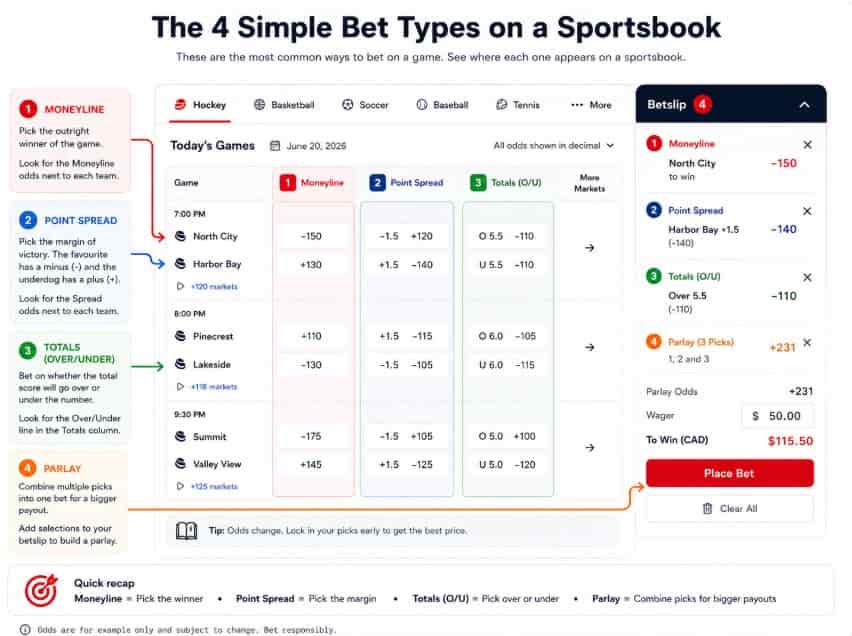 Click to enlarge
 A moneyline bet is the simplest bet on the board. You are just picking the winner of the game or event. There is no scoring handicap and no margin to cover. If the team or player you backed wins, your bet wins. If they lose, your bet loses. That is why moneyline betting is usually the first market beginners understand and the first one many guides explain.
The only extra detail is the price. Favourites have shorter odds and smaller returns, while underdogs have longer odds and bigger potential profit. In some sports, especially football and some hockey markets, you may also see a 3-way moneyline, where the draw is its own option. That matters because a team can win the match after extra time and still lose a 3-way moneyline bet if the game was level at the end of regulation.
A point spread bet adds a handicap to make an uneven matchup more balanced from a betting point of view. The favourite is listed with a minus number and must win by more than that margin. The underdog is listed with a plus number and can either win outright or lose by less than the spread and still cash the bet. This is why people often say spread betting is not just about winning, but about covering.
For example, if a team is -4.5, it needs to win by five points or more. If the other side is +4.5, that bet wins if the team loses by four or fewer, or wins the game. Spread betting is especially common in sports like American football and basketball, where one side may be stronger but the match can still be bet in a more even way once the handicap is added.
A totals bet, also called an over/under bet, is about the combined score rather than the winner. The sportsbook sets a line, such as 5.5 goals in hockey or 44.5 points in football, and you decide whether the final total will go over or under that number. This is a useful market if you have a strong opinion about game flow, tempo, attack, defence or weather, but do not feel strongly about which side will win.
That makes totals one of the most beginner-friendly markets after the moneyline. You are not worrying about whether the favourite wins by enough. You are simply asking whether the game is likely to be high-scoring or low-scoring. Competitor guides regularly treat totals as one of the three core markets for exactly that reason.
A parlay combines two or more selections into one bet. The attraction is obvious: the odds are multiplied together, so the payout can become much bigger than staking on each pick separately. The trade-off is just as important: every leg has to win. If one leg loses, the whole parlay loses. That is why parlays are common, exciting and easy to understand, but also much riskier than a straight moneyline, spread or total bet.
For a beginner, the key thing to remember is that a parlay is not a better version of a single bet. It is a higher-risk product. Some guides correctly point out that parlays are heavily promoted and can look more attractive than they really are, especially when you focus on the payout instead of the chance of winning. If you are just starting out, parlays are usually better treated as an occasional extra rather than your default bet type.
A beginner usually does not need more markets. They need a better way to choose the right market for the opinion they already have. Once you link each market to a specific prediction, the decision becomes more straightforward.
If you only want to pick the winner: choose the moneyline when your opinion is simply “this team wins” or “that player wins”. It is the cleanest market and usually the best place to start.
If you think the margin matters: choose the point spread when you think the favourite should win comfortably or the underdog can keep the game close.
If you want to bet on the game rather than a team: choose the total when your read is about pace, scoring, weather, attack or defence.
If you want a bigger payout and accept more risk: choose a parlay only if you understand that the higher return comes with a lower chance of winning.
A quick look at how the four simple markets differ.
| Market | What you are betting on | Typical question | Win condition | Best for | Risk level |
|---|---|---|---|---|---|
| Moneyline | Which team or player wins | Who wins? | Your pick wins | Strong lean on the winner | Low |
| Point Spread | Win or lose within a margin | By how much? | Cover the spread | Close games or uneven matchups | Medium |
| Totals | Combined score over or under | How much scoring? | Over or under hits | Views on pace and scoring | Medium |
| Parlays | Multiple picks in one ticket | Can several picks all win? | Every leg wins | Higher payout potential | High |
A team can win the match and still fail to cover the spread. This is one of the first beginner mistakes because many new bettors instinctively think “my team won, so my bet won.” That is true on a moneyline, but it is not always true on a spread. If you are betting handicaps, always check the number, not just the final result.
Not every market is graded the same way. A 2-way moneyline is different from a 3-way moneyline, and some markets settle at the end of regulation while others include overtime or extra time. This matters most in football and hockey, where the draw can be part of the market.
Parlays are easy to enjoy because the payout grows quickly, but that is also why they can pull beginners away from better habits. Treat parlays as optional entertainment, not as the standard way to bet.
One of the safest beginner habits is to start small. iGaming Ontario’s onboarding advice and responsible-gambling bodies consistently tell players to treat gambling as entertainment, decide on time and money limits in advance, and only gamble with money they can afford to lose.
If your audience is in Canada, it is worth adding one short regional note so the page feels locally useful without becoming a law guide. For Ontario readers, iGaming Ontario says players should look for regulated operators in Ontario and the iGaming Ontario logo, because regulated sites come with player protections, responsible-gambling tools and formal oversight. That is a simple but high-trust message to include on a beginner page.
It also makes sense to remind beginners that the safest first bet is not the most exciting one. It is the one they understand. Learn the market first, use the operator’s limit-setting tools, and keep the session small while you are still learning the difference between moneyline, spread, total and parlay betting.
Responsible Gambling Guide → Look for regulated Ontario operators.
If the four basic markets now make sense, the next step is not to learn every advanced bet at once. It is to connect the bet type to odds, stake, payout, bookmaker choice and safer play.