

Odds, stake, payout and implied probability
A beginner’s guide to betting odds, payouts and how implied probability works in sports betting.
Odds show the price of a bet and the market’s implied view of likelihood. Your stake is what you risk, your payout is what you receive if the bet wins, and implied probability turns odds into a percentage so prices are easier to compare.
In sports betting, odds tell you two things at once: how likely the market thinks an outcome is, and how much a winning bet would return. Your stake is the amount you risk. Your payout, often called your return, is the amount you receive back on a winner, usually including your original stake.
Implied probability turns the odds into a percentage, which makes it much easier to compare prices, understand favourites and underdogs, and see where bookmaker margin sits inside the market. Once you understand these four ideas, a betting slip becomes much easier to read.
New to betting terms? Start with our sports betting glossary for plain English definitions of key words like vig, moneyline, favourite and underdog.
What these terms mean
Before looking at formulas, it helps to separate four terms that beginners often blend together. Odds are the price. Stake is the amount risked. Payout is the total amount returned if the bet wins. Implied probability is the chance hidden inside the price.
Odds
Odds are a pricing system for probability. If a team is a strong favourite, the odds will be short because the market thinks that result is more likely. If a team is a clear underdog, the odds will be bigger because the outcome is considered less likely.
Stake
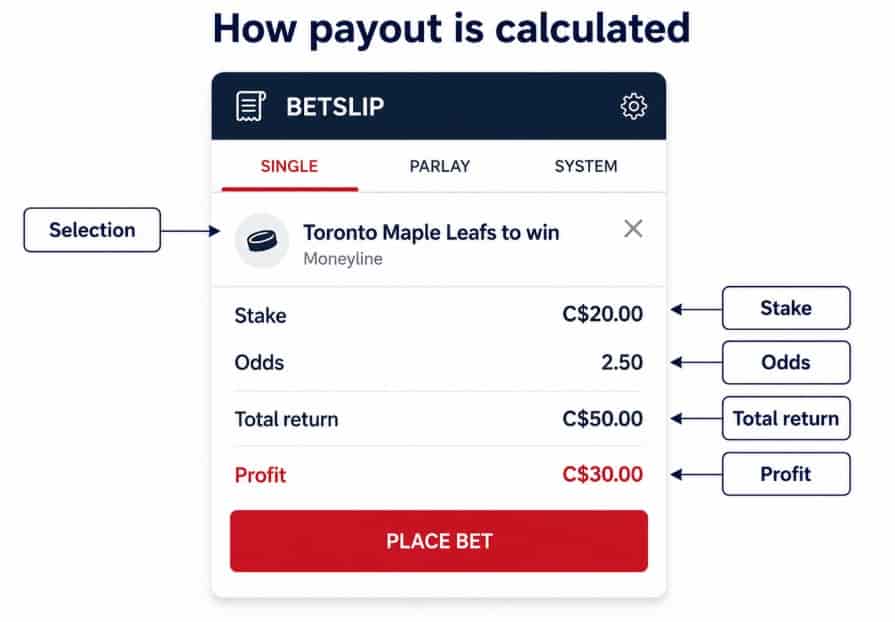
The stake is simply your wagered amount. If you stake C$20, that C$20 is what you are putting at risk. If the bet loses, you lose the stake. If the bet pushes or is void, the stake is normally returned.
Payout, return and profit
Payout and return are often used interchangeably. They usually mean the total amount you get back on a winning bet: original stake plus profit. Profit is the smaller number left after you subtract the stake from that total.
Implied probability
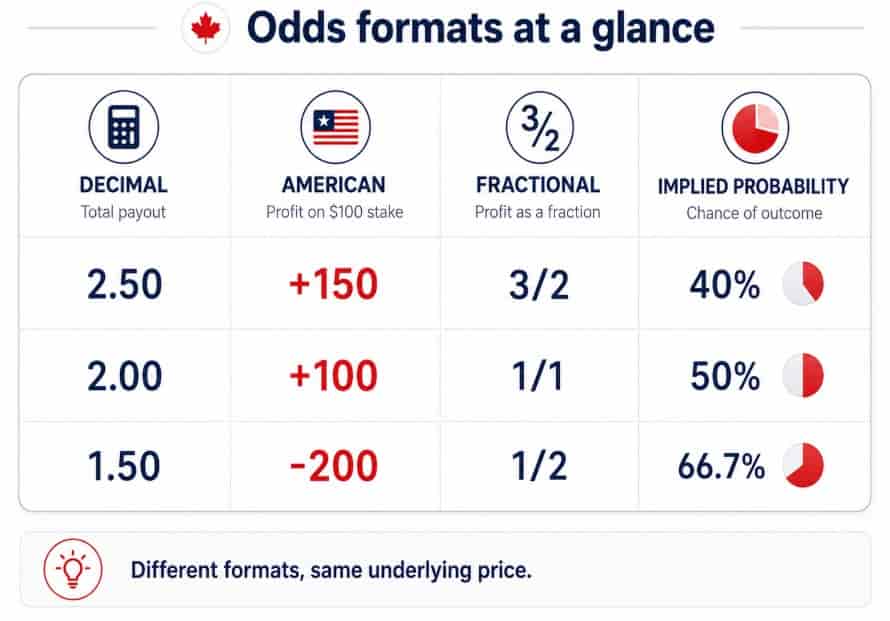
Implied probability translates betting odds into a percentage. A line of 2.00 in decimal odds or +100 in American odds may look different from 1/1 in fractional odds, but each represents a 50% implied chance.
The three main odds formats
Most beginner pages separate this topic into decimal, fractional and American odds, because readers need to recognise the format before they can calculate anything. The same bet can be shown in any of the three, but the maths underneath is the same.
Decimal odds
Decimal odds show total return per unit staked. If the odds are 2.50 and you stake C$20, your total return is C$50.
2.50 × C$20 = C$50Fractional odds
Fractional odds show profit relative to stake. At 3/2, you win C$3 for every C$2 staked, then receive your stake back.
3/2 = C$30 profit on C$20American odds
Positive odds show profit on a C$100 stake. Negative odds show how much you need to stake to win C$100 profit.
+150 or -150Odds format comparison table
The comparison table below uses standard sportsbook formulas to show how the same pricing idea appears in all three formats.
| Market view | Decimal | Fractional | American | Implied probability | Profit on C$10 stake | Total return |
|---|---|---|---|---|---|---|
| Favourite | 1.50 | 1/2 | -200 | 66.7% | C$5.00 | C$15.00 |
| Even money | 2.00 | 1/1 | +100 | 50.0% | C$10.00 | C$20.00 |
| Underdog | 3.00 | 2/1 | +200 | 33.3% | C$20.00 | C$30.00 |
The practical lesson is simple: the format changes, but the meaning does not. Once you can convert any price into a percentage and a return, you can compare markets much more confidently. If you understand the odds but not the market names yet, go next to our main bet types guide.
How payout is calculated
A good beginner page cannot stop at definitions. Readers usually want to know what a C$10 or C$20 bet could actually return, which is why calculators and beginner guides nearly always include a formula block or worked example.
Decimal payout formula
stake × decimal odds = total returnIf the odds are 1.80 and the stake is C$20, the return is C$36. The profit is C$16.
Fractional payout formula
stake × numerator / denominator = profitAt 5/2, a C$20 stake makes C$50 profit, so the total return is C$70.
American payout formula
+ odds: stake × odds / 100
- odds: stake × 100 / odds
A C$20 bet at +150 returns C$50 total. A C$20 bet at -150 returns about C$33.33 total.
Worked example with a C$20 stake
Imagine one selection priced at 2.50, 3/2, or +150 depending on the format you choose. These are different displays of the same market price. A C$20 stake returns C$50 in total and makes C$30 profit.
If the same event were priced at 1.67 or roughly -150 instead, a C$20 stake would return about C$33.33, which is only C$13.33 profit because the outcome is considered more likely. Bigger payouts usually mean lower implied probability, not better value by themselves.
Quick payout calculator
To verify different examples quickly, use the payout calculator on this page.
How implied probability is calculated
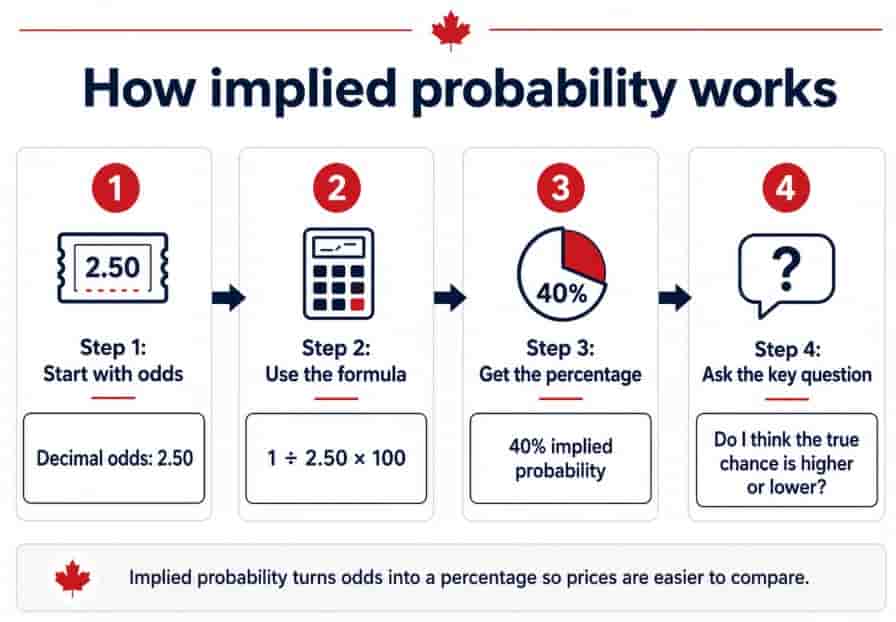
Payout tells you the possible return. Implied probability tells you what the market thinks the chance is. Both matter, but the percentage view is often better for decision-making because it lets you compare the bookmaker’s view with your own estimate.
Decimal odds to percentage
1 / decimal odds × 100Decimal odds of 2.50 imply a 40% chance because 1 / 2.50 = 0.40.
Fractional odds to percentage
denominator / (numerator + denominator) × 100Fractional odds of 3/2 become 2 / (3 + 2) × 100 = 40%.
American odds to percentage
+ odds: 100 / (odds + 100) × 100
- odds: odds / (odds + 100) × 100
+150 implies 40%, while -150 implies 60%.
Quick implied probability calculator
For a beginner page, raw implied probability is enough. More advanced analysis sometimes removes overround so the market adds up to 100%, and academic work also looks at favourite-longshot bias and different normalisation methods. That matters later; for now, the key step is learning what percentage is built into the price you are seeing. You can also use our odds converter when books show different formats.
Why implied probability matters
If you only read odds as payout, you can be drawn toward prices that look exciting without noticing how unlikely they are. Implied probability corrects that. It shows that +200 is not just “a chance to win double”; it is also a market estimate of roughly 33.3%.
Spotting value and reading the market
If your own research suggests a team wins 45% of the time and the market price implies only 40%, the number may be attractive. If your estimate is lower than the implied probability, the price is likely poor.
Why percentages can exceed 100
When you add the implied probabilities of both sides of a market, the total often comes out above 100%. That extra percentage is the bookmaker margin, also called vig, juice or overround.
A standard two-way market at -110 on both sides implies about 52.4% for each side, or roughly 104.8% in total. That does not mean both sides can happen; it means the sportsbook has built its edge into the line. This is why price comparison matters and why bankroll management matters once you start thinking in probabilities.
Common mistakes and useful next guides
The most common beginner error is confusing profit with payout. The second is comparing prices in mixed formats without converting them first. The third is ignoring market rules: a void or push normally returns the stake, while different sports and bet types can settle in different ways.
Confusing payout with profit
Your payout normally includes your original stake. Profit is what is left after you subtract the stake.
Comparing mixed formats
Decimal, fractional and American odds can all describe the same price. Convert them before comparing.
Ignoring settlement rules
A push, void or dead heat can change how a bet is paid. Always read the market rules before staking.
Forgetting responsible limits
Better maths does not remove risk. Decide your budget first and use safer gambling tools when needed.
This page should act as a hub, not a dead end. If a term still feels unfamiliar, the next click should be a glossary. If the maths makes sense but the market names do not, the next page should be main bet types. If the question is how much to risk rather than how much you could win, the next step is bankroll management, followed by betting calculators and odds converter tools.
For Canadian readers, it also makes sense to review responsible gambling resources before betting. In Ontario, regulated operators must be registered and authorised within the provincial framework, and the regulated market is built around player protections, fair play standards and responsible-gambling tools.
Build your beginner toolkit
Once odds, stake, payout and implied probability make sense, the next step is to connect the maths to real markets, safer staking and Canadian rules.