

What sports
betting is
A beginner’s guide to betting basics in Canada.
Sports betting means risking money on a sports outcome, such as who wins, how many points are scored, or whether a player hits a stat. Odds show the possible payout and the sportsbook’s implied view of likelihood. This guide is for Canadian beginners who want the basics before placing a bet.

Ready to compare the best options?
See our expert reviews of Canada’s top regulated sportsbooks.
What sports betting is
Sports betting is the act of placing money on the outcome of a sporting event or a specific event within a game. You choose a selection, add a stake, and accept odds that decide how much you could win if your bet is correct. If the bet loses, you lose your stake. In simple terms, sports betting is a mix of prediction, price and risk.
For beginners, the most useful way to understand sports betting is not as a shortcut to easy money, but as a system with its own language, pricing and rules. This guide explains the basics in plain English, with Canadian context where it matters. If you are new to the terminology, keep our sports betting glossary nearby while you read.
This page is designed as a starting hub, not a page that tries to answer every betting question in one sitting. Each section gives the basic answer first, then points to a deeper guide when the topic deserves its own page.
How sports betting works
What a sportsbook does
A sportsbook, sometimes called a bookmaker, publishes markets for games and events. Each market has selections and odds. You choose the outcome you want, enter your stake in the betslip, and the sportsbook shows your potential return before you confirm the bet.
A useful way to picture a sportsbook is as the shop window for betting markets. It does not only list games; it also prices each possible outcome through odds. Those odds can move before and during an event because sportsbooks respond to new information, betting activity, injuries, lineup changes and risk management.
How a betslip works
The betslip is the place where your chosen selection becomes a possible wager. After you click a team, total, player prop or other selection, it appears in the betslip with the current odds. You then enter your stake, check the potential return, review the market name and confirm the bet only if everything looks right.
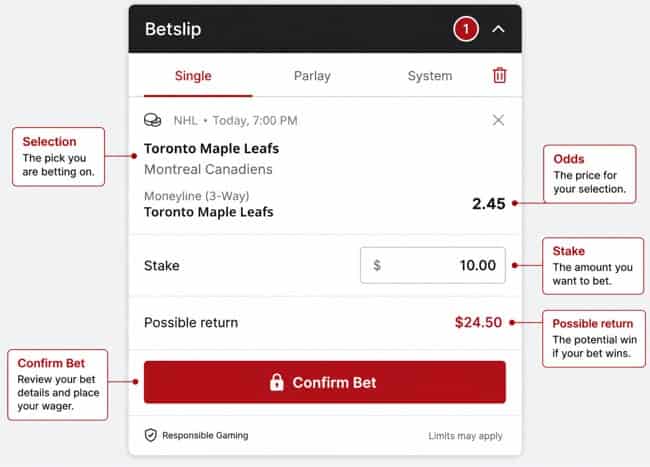
Beginners should treat the betslip like a checkout page: slow down, read the details, and make sure you are not accidentally building a parlay when you meant to place a single bet.
Stake, return and payout
Your stake is what you risk. Your return is the total amount the sportsbook gives back if the bet wins. Your profit is the return minus the stake. Some sites use payout as a general term for what you receive if the ticket wins.
For a deeper explanation of betting terms, go to the sports betting glossary. For worked examples that show how stake, return and profit fit together, read stake and payout explained.
What the odds mean
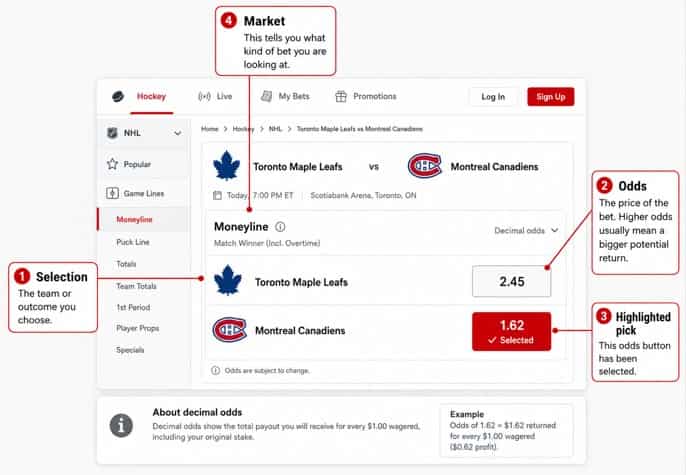
Odds do two jobs at once: they show the price of a bet and they imply how likely the sportsbook thinks an outcome is. Higher odds usually mean a bigger possible win but a less likely outcome. Lower odds usually mean a smaller return and a more likely outcome.
Decimal, American and fractional odds
In Canada, many bettors are comfortable with decimal odds, though many sportsbooks also let you switch to American odds. If decimal odds are 2.50 and you stake $10, your total return is $25. That includes your original $10 stake, so your profit is $15.
With American odds, +150 means a $100 bet would win $150 in profit, while -150 means you would need to risk $150 to win $100 in profit. Fractional odds are another format you may see, especially in content influenced by UK or horse racing markets.
| Odds format | Example | Beginner meaning |
|---|---|---|
| Decimal | 2.50 | A $10 stake returns $25 total if it wins. |
| American | +150 | A $100 stake wins $150 profit if it wins. |
| American | -150 | You risk $150 to win $100 profit. |
| Fractional | 3/1 | You win $3 profit for every $1 staked. |
Implied probability in simple terms
Implied probability is a quick way to translate odds into a percentage. With decimal odds, the simple version is 1 divided by the odds. So decimal odds of 2.50 imply a 40% chance.
You do not need to become a full maths nerd on day one, but this idea helps you understand what a price is really saying. It also teaches an important beginner lesson: odds are not just about who you think will win, but about whether the price is good enough.
The main bet types beginners should know
You do not need to learn every market at once. Most beginners should start with a small set of simple markets: moneyline, point spread or handicap, totals, and then props or parlays once the basics are clear.
Moneyline
A moneyline bet is the simplest one. You are just picking the winner. There is no margin requirement, which makes it one of the best first markets for new bettors.
Moneyline betting →Point spread and handicap
A point spread or handicap bet adds a margin. If a team is -3.5, it must win by four or more for that side to cover.
Point spread betting →Totals
A totals bet, also called an over/under, is about combined scoring rather than the winner. If a total is 48.5, the over needs 49 or more.
Over/under betting →Props and parlays
Props focus on a specific event within a match. Parlays combine multiple selections into one ticket and are harder to win because every leg must be correct.
Parlay betting →If you are just starting, keep parlays small and treat them as optional, not as your default. A reader should leave this section thinking: “I can start with singles, learn the core markets, and save complex tickets for later.”
How to choose a sportsbook in Canada
Regulated versus unregulated options
The first filter is not a bonus. It is legality and regulation. Beginners should start with regulated options where they live. That does not mean every regulated sportsbook is identical, but the legal and consumer-protection layer comes before odds boosts, welcome offers or app design.
For Ontario readers, look for a regulated operator and check the official regulated-site information before signing up. For readers outside Ontario, the right legal path depends on the province or territory.
If a reader is in Ontario, send them toward the official regulated-operator check first, then your sportsbook review hub. If a reader is outside Ontario, remind them that rules and available products can vary by province or territory.
Features that matter more than promos
After legality, beginners should compare the things that make betting easier to understand: a clear betslip, transparent rules, easy odds-format switching, sensible payment methods, and visible responsible gambling controls.
Bonuses can help, but for a first-time bettor, clarity is worth more than noise. Does the sportsbook explain market rules clearly? Can you switch between decimal and American odds? Are deposit limits easy to find? Is customer support visible before you need it?
Is sports betting legal in Canada?
Yes, sports betting is legal in Canada, but the details depend on the province or territory. Federally, the Safe and Regulated Sports Betting Act amended the Criminal Code so provinces could conduct and manage betting on a single sport event or athletic contest.
What changed in 2021
Before the 2021 change, Canada’s federal rules limited how single-event sports betting could be offered. The important beginner takeaway is that the law changed to allow provinces and territories to conduct and manage single-event sports betting.
What Ontario readers should check first
For Ontario readers, the practical date is April 4, 2022, when Ontario launched its regulated iGaming market. Players should check whether a site is regulated, whether they meet the age requirement, and whether they are physically located in the province when using Ontario-regulated sites.
In other provinces, minimum age, available products and operator rules can differ. Check the rules where you live before signing up or placing a bet.
How to bet responsibly from the start
Bankroll basics
The safest beginner mindset is simple: treat sports betting as entertainment, not as income. Decide how much time and money you want to spend, stick to it, and gamble only with money you can afford to lose.
Bankroll management sounds technical, but the beginner version is plain: decide your betting budget before you bet, keep stakes small, and do not increase them because you feel frustrated. A bankroll is not rent money, savings money or emergency money.
Safer gambling tools and where to get help
In practice, responsible betting means starting with small single bets, using a flat stake while you learn, tracking your results, and avoiding emotional decisions after wins or losses.
This is also the right place to mention sportsbook tools such as deposit limits, loss limits, time reminders, cool-off periods and self-exclusion. Beginners should set limits before they feel they need them. That is not a sign of weakness; it is like wearing a seatbelt before driving.
Common beginner questions
What is the easiest sports bet for a beginner?
A single bet on a simple market such as moneyline or totals is usually the easiest place to start because the rules are clearer and there are fewer moving parts than in parlays or complex props.
What does implied probability mean?
It is the percentage chance suggested by the odds. It helps you move from “Who do I think will win?” to “Is this price worth taking?” That is one of the most useful mindset shifts for new bettors.
Is sports betting legal in Canada?
Yes, but the legal products, approved operators and minimum age depend on the province or territory. Beginners should check the rules where they live before signing up.
How much should a beginner stake?
Start with a small flat amount that you can comfortably afford to lose and keep it consistent while you learn. The key beginner goal is control, not fast growth.
What should I learn before placing my first sports bet?
Start with the basic vocabulary, then learn how odds, betslips, stake, return and simple bet types work. A good first learning path is glossary, odds, moneyline, totals, bankroll and legal rules.
Are parlays good for beginners?
Parlays are easy to build but harder to win because every selection on the ticket must be correct. A single bet is usually better for learning because it shows the relationship between one selection, one set of odds, one stake and one result.
What makes this guide different from a betting tips page?
This page is about understanding the system, not telling you what to bet on. It explains definitions, odds, bet types, sportsbook choice, legality and responsible gambling basics.
Start with these beginner resources
If this page gave you the basics, the best next step is not a random bet. It is knowledge. Start with the glossary, then read how betting odds work, implied probability, simple bet types, bankroll management and Canada’s legal rules.
Free, confidential support is available for you or someone you care about.
Get help now →1-866-531-2600
Available 24/7
Find a meeting near you
gamblersanonymous.org
Problem gambling support and treatment