Following the UEFA Champions League in Canada is (thankfully) straightforward once you know who holds the rights. UEFA lists Canada’s broadcast partner for the 2025/26 competition as DAZN, and DAZN has also publicly confirmed it retained exclusive Canadian rights to UEFA club competitions for the 2024/25–2026/27 cycle.

This guide focuses on the full tournament journey — from the league phase through to the knockout rounds and the final — with practical advice on kick-off times, devices, and watching at home versus in public venues.
Table of contents:
Main official viewing option in Canada
For the 2025/26 season, UEFA lists DAZN as the official broadcast partner in Canada.
In practical terms, your main “watch” workflow is:
- subscribe to DAZN in Canada;
- use the DAZN app or website on a supported device;
- find the match live (or watch on-demand later, where available).
DAZN positions its Champions League coverage in Canada as live and on-demand streaming, and it maintains a dedicated Champions League competition hub (which typically includes match tiles, related shows, and highlight programming).

Main official viewing option in Canada
Generally, yes — streaming availability is not restricted to one province, and Canadians can typically access DAZN from anywhere in the country, assuming they have a compatible device and a stable internet connection. DAZN publishes a supported-devices list covering smart TVs, streaming devices, mobile phones/tablets, and web browsers.
The biggest “nationwide” limitations are usually practical (not geographic):
- Your internet quality: DAZN recommends download speeds of roughly 3 Mbps for SD, 9 Mbps for HD, and around 16 Mbps for full HD (1080p).
- Territorial rights when travelling: DAZN’s portability guidance explains that logging in while travelling can change what you can watch, depending on rights in the country you’re visiting (in other words, travelling outside Canada can affect the catalogue).
If you’re comparing options, it’s also sensible to keep an eye on UEFA’s “where to watch” page (it’s explicitly designed as the authoritative directory by territory).
2025/26 UEFA Champions League Schedule and Kickoff Times in Canada
The 2025/26 Champions League is played under the modernised format introduced in 2024/25 — meaning the opening stage is a single league phase rather than the old four-team group stage. That affects not just the standings, but also how many matchdays you’re planning for and why some weeks are especially busy.
Key stages of the tournament
The tournament structure breaks down into three big viewing blocks (plus qualifying, if you follow that too):
League phase (8 matchdays): UEFA lists matchdays for 2025/26 as 16–18 September 2025, 30 September–1 October 2025, 21/22 October 2025, 4/5 November 2025, 25/26 November 2025, 9/10 December 2025, 20/21 January 2026, and 28 January 2026.
Knockout phase: UEFA’s published dates show the knockout phase play-offs in February 2026, the round of 16 in March 2026, quarter-finals in April 2026, semi-finals spanning late April and early May 2026, and the final on 30 May 2026.

How qualification works: UEFA’s new-format explainer states that 36 clubs are ranked together in the league phase; each team plays eight matches against eight different opponents (home and away split), the top eight go straight to the round of 16, and teams 9th–24th go into a two-legged knockout phase play-off for the remaining round-of-16 spots.
A scheduling detail many fans miss: UEFA explains that each UEFA men’s club competition has an “exclusive week.” In the Champions League exclusive week, matches can be played on Tuesday, Wednesday, and Thursday (not just the usual Tuesday/Wednesday).
Match times across Canadian time zones
UEFA’s guidance on kick-off windows makes planning much easier. It notes that matches in the league phase, the knockout phase play-offs, and the round of 16 can kick off at 18:45 CET or 21:00 CET, and that the final matchday of the league phase is played simultaneously at 21:00 CET (with UEFA able to grant exceptions).
In Canada, that usually translates into midday and afternoon kick-offs, because Canada sits several hours behind Central Europe. Canada also spans multiple time zones, and daylight saving time is set by provincial legislation, with some exceptions by municipality — so the safest habit is to confirm the local start time in the match listing (UEFA fixtures page or the DAZN match tile), especially around daylight saving time changeovers.

As a typical rule-of-thumb for Canadian viewers (based on the standard UEFA kick-off windows and the usual UTC offsets shown for major Canadian cities), you can expect:
- Pacific time (example: Vancouver): roughly 09:45 (for 18:45 CET/CEST) and 12:00 (for 21:00 CET/CEST).
- Mountain time (example: Calgary): roughly 10:45 and 13:00.
- Central time (example: Winnipeg): roughly 11:45 and 14:00.
- Eastern time (examples: Toronto and Montréal): roughly 12:45 and 15:00.
- Atlantic time (example: Halifax): roughly 13:45 and 16:00.
- Newfoundland time (example: St. John’s): roughly 14:15 and 16:30 (note the half-hour offset).
Finally, note the special case for the final: UEFA has confirmed that starting with the 2025/26 season, the Champions League final kick-off moves to 18:00 CET, and UEFA’s final-specific ticket support page lists the 2026 final as 18:00 CEST on 30 May 2026.
Best Ways to Watch Champions League Matches in Canada
The Champions League is one of those competitions where your viewing setup matters: matches are live, often simultaneous, and the biggest knockout nights tend to expose weak Wi‑Fi and outdated apps. DAZN’s own help resources focus on exactly those friction points: device compatibility and connection quality.
Streaming at home
For most viewers, streaming at home is the best mix of comfort and reliability — especially on busy match nights when you want a stable picture and uninterrupted audio.
DAZN recommends download speeds of about 9 Mbps for HD and 16 Mbps for full HD (1080p), and it notes that you’re more likely to get top quality with a stable, high-speed connection. Practically, that means: if you can use Ethernet (wired) or sit close to your router for Wi‑Fi, you reduce the risk of buffering when tens of thousands of fans are watching the same match.

If you’re trying to follow multiple matches in the league phase (or a simultaneous final matchday), it’s also worth checking whether your plan supports concurrent viewing or special viewing modes (DAZN’s plan page in Canada references watching on multiple devices and a Multiview feature). Features can change, so confirm what your subscription includes before a big match night.
Watching on smart TVs and mobile devices
DAZN supports a wide range of devices — including smart TVs, mobile phones/tablets, and web browsers — and publishes a current supported-devices list. This is useful if you switch between living-room viewing (TV) and personal viewing (phone/tablet) depending on the day’s schedule.
If your household shares one account, treat a Champions League night like a “high demand” event: confirm everyone knows the login, ensure apps are updated on the device you’ll actually use, and check any plan limits that might affect simultaneous streams. DAZN’s Canada pricing/help page outlines plan tiers and includes notes about watching on multiple devices at the same time.
Watching while travelling in Canada
If you’re travelling within Canada, your experience is usually similar to home: you sign in and watch through the app or browser on a supported device. The main variable is connection quality (hotel Wi‑Fi can be unpredictable), so streaming on a stable connection — or testing beforehand — can save you frustration.
If your travel takes you outside Canada, rights become a bigger issue. DAZN’s portability guidance says you can log in while travelling, but availability depends on what’s licensed in the country you’re visiting, and it highlights that some content may be free-only or limited to “global rights” programming while abroad. In other words: if you might cross the border during the tournament, expect the catalogue to change.
Province-Specific Viewing Options
Because the official Canadian rights holder is the same nationwide, “province-specific” doesn’t usually mean “different broadcasters.” Instead, the province-specific differences that actually affect viewers are:
- what time matches start in your part of Canada;
- how realistic public viewing is (opening hours, match sound, bookings);
- whether daylight saving time quirks apply in your area.
Ontario and Quebec
In Ontario and Quebec (especially areas aligned with Eastern time), Champions League matches usually land in a very watchable window: the common UEFA kick-off times often translate to early afternoon (roughly 12:45 and 15:00 in Eastern Canada). That makes it easier to follow the league phase on workdays (with a later lunch break) and to make an event out of weekend fixtures like the final.

The other practical advantage here is flexibility: you can more easily choose between home streaming and public venues because you’re not asking venues to open at breakfast time. Still, for the final matchday of the league phase — where UEFA plays fixtures simultaneously — you may prefer home viewing if you care about switching between matches.
British Columbia and Alberta
In British Columbia and Alberta, Champions League is often a morning-to-midday watch — which can be brilliant (breakfast football) but does affect your venue options. The standard UEFA kick-off windows typically mean late-morning or lunchtime starts in Western Canada.

If you’re planning to watch in a bar, the biggest question becomes opening hours (and whether they’ll play match audio). If you want a guaranteed setup — especially for high-profile knockout nights — streaming at home is usually the simplest option in the West.
Prairie provinces and Atlantic Canada
This is the one place where it matters to think beyond “province name” and focus on time zones and daylight saving rules.
For the Prairies, the standard UEFA kick-off windows commonly translate to late morning and early afternoon depending on your exact location. One important exception: Saskatchewan does not use daylight saving time in the same way most provinces do, which can affect the local clock relationship at certain points in the season — so it’s worth checking the match listing on the day if you’re near a time-zone edge or travelling between provinces.
For Atlantic Canada, matches skew a bit later in the afternoon, and for Newfoundland and Labrador they can be later still because Newfoundland time is a half-hour offset. These time differences are exactly why UEFA’s fixtures page (and the DAZN match tile) is the best last-step confirmation for “what time is kick-off for me?”
Unofficial Free Sources to Watch the UEFA Champions League in Canada
Finding free ways to watch the UEFA Champions League in Canada isn’t always straightforward, especially with most official broadcasts locked behind paid subscriptions. That’s why many fans turn to unofficial streaming sources to catch live matches without the added cost. These platforms vary widely in quality, reliability, and safety, so knowing what to expect can make a big difference in your viewing experience. Below, you’ll find a curated list of commonly used sites, along with insights into how they work, what they offer, and when they might fall short – helping you stream smarter and avoid unnecessary frustration.
SportsSurge
Working link: https://sportsurge.ws/
SportsSurge is considered the successor to r/soccerstreams, offering a clean, minimalist aggregator for sports streams. It avoids aggressive ads and focuses on usability, listing matches by sport and league with multiple stream options ranked by community votes. This system helps highlight reliable, high-quality links while filtering out broken ones. Please bear in mind that the working link may change over time, so if it not working you may need to find a working one yourself.
It covers a wide range of sports, including soccer, basketball, football, MMA, and boxing. Although it doesn’t host streams, its role as a trusted directory makes it popular among users seeking a simple, ad-light experience.
What to Expect
The homepage lists live and upcoming events in a clean layout. Clicking a match reveals streams with ratings, bitrate info, and sometimes commentary details. Top-rated links are usually stable and offer 720p–1080p quality. Streams redirect to third-party sites, which may include pop-ups, but poor links are quickly downvoted. The experience is smooth overall, with easy switching between links if one fails.
When to Avoid It
Less useful for niche events due to reliance on community submissions. During major PPV events, the site may slow down, and streams can fail. Use a VPN on public Wi-Fi due to risks from third-party sites.
FootyBite
Working link: https://www.footybite.do/
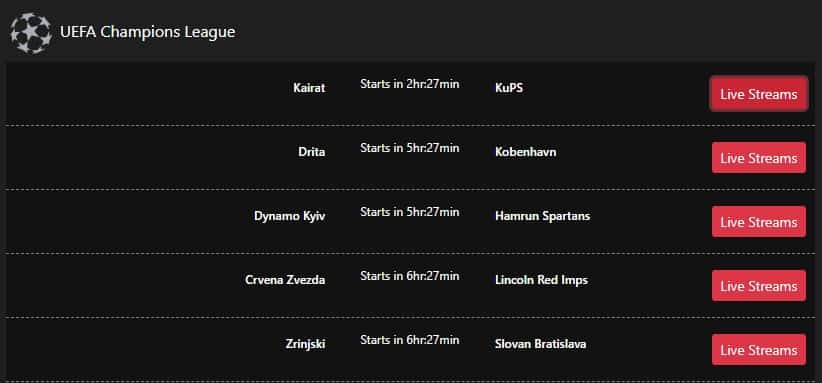
FootyBite began as a soccer-focused aggregator and still centers on football content. It stands out by embedding streams from platforms like Twitch or YouTube, reducing pop-ups and improving stability. Matches are organized by competition, and the site includes highlights and community elements. Its cleaner experience and use of mainstream platforms make it a favorite among soccer fans. Please bear in mind that the working link may change over time, so if it not working you may need to find a working one yourself.
What to Expect
The site displays matches by competition, with multiple stream options per game. “Bite” links (embedded streams) load quickly and avoid heavy ads. External links are also available but may include pop-ups. Streams are stable and often go live 15–30 minutes before kickoff. A comment section helps users share backup links.
When to Avoid It
Not ideal for niche sports, as coverage outside soccer is limited. High-demand matches may hit viewer caps or face takedowns. Some embedded streams may not work on restricted networks.
VIPRow
Working link: https://viprow.im/
VIPRow is a long-running streaming site with a dated but functional design. It covers a wide range of sports, including niche and international events. Each event includes multiple links, making it easy to switch if one fails. While ad-heavy, it works well with ad blockers and is valued for its extensive coverage. Please bear in mind that the working link may change over time, so if it not working you may need to find a working one yourself.
What to Expect
The site lists events by sport, with each match offering several external links. Quality varies widely, and users may need to try multiple links. Streams generally start on time, and backup options ensure availability. There’s no voting or chat system, so it relies on trial and error.
When to Avoid It
Difficult to use without an ad blocker due to excessive pop-ups. Mobile users may struggle. During major events, many links may be broken or overloaded.
BuffStreams
Working link: https://buffsports.io/
BuffStreams offers a simple, no-frills way to access sports streams. Its minimal layout allows quick access to games without registration. However, it relies heavily on ads, including pop-ups and redirects. With proper tools like ad blockers and VPNs, it provides reliable 720p–1080p streams across major sports. Please bear in mind that the working link may change over time, so if it not working you may need to find a working one yourself.
What to Expect
The homepage lists events, and clicking one opens an embedded player after pop-ups. Streams are stable with minimal buffering, and multiple sources may be available. There’s no chat, keeping the focus on viewing. The schedule helps users plan ahead.
When to Avoid It
Avoid on shared or unsecured devices due to aggressive ads and potential malware risks. Not ideal without ad blockers. During major events, streams may lag or drop due to high traffic.
FAQ About Watching the UEFA Champions League in Canada
Is the tournament available across Canada?
UEFA’s official broadcast partner listing shows Canada’s partner as DAZN for the Champions League, and DAZN has also confirmed it retained exclusive Canadian rights to UEFA club competitions through the 2026/27 season. Taken together, that means Canadian viewers should generally expect Champions League matches to be available nationwide through DAZN (subject to subscription, device support, and internet quality).
Because rights can be re-tendered or sublicensed over time, the safest “final check” before a big match is UEFA’s “where to watch” directory for your territory.
What time do Champions League matches usually start in my province?
UEFA indicates that most matches (league phase, knockout phase play-offs, and round of 16) kick off at 18:45 CET or 21:00 CET, with the final league-phase matchday played simultaneously at 21:00 CET.
In Canada, those windows typically translate to late morning/afternoon depending on your time zone — and Canada’s official timekeeping rules vary by province and, in some areas, by municipality. That’s why the most accurate answer for any specific game is the match listing (UEFA fixtures) displayed in your local time zone on the day.
Can I watch on phone, laptop, or TV?
Yes — DAZN supports viewing on a wide range of devices, including mobile devices, smart TVs, and web browsers, and it maintains an updated supported-devices list.
For the best experience on match nights, DAZN recommends having enough bandwidth for the quality you want (HD and full HD require higher download speeds), and it notes that stable connections reduce buffering and quality drops.